
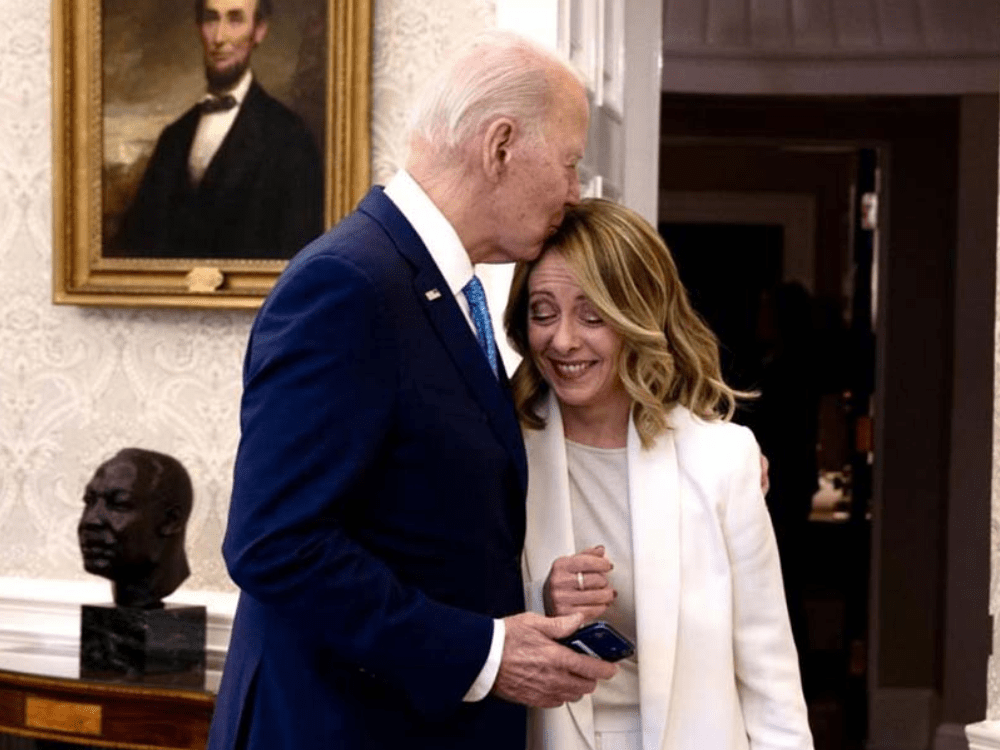
A greeting between heads of states or a paternal act of benediction?
My Italian doctor has decided: This time around, he’ll cheer for Trump. Though his vote of confidence is meaningless, his motives are not. And those motives took form thanks in part to that semblance of a kiss.
When Italian Prime Minister Giorgia Meloni recently visited the White House, President Joe Biden, who towered over her, planted a gentle, grazing kiss (all Italian media call it that) on her head. She could have been his appreciative sister.
Myy doctor described this kiss as fa tenerezza, which loosely translated suggests an act of tenderness akin to condescension. Fa tenerezza usually comes with an implied whiff of pity.
His own tender disdain reflects a long-standing weariness some Italians cannot help but ascribe to their country’s fawning attitude toward the United States, the World War II liberator most Italian leaders can’t bear to criticize. Meloni’s political ally, the late Silvio Berlusconi, openly revered Washington during his nearly 10 years of prime ministership. Among the few European heads of state to pal around with Russia’s Vladimir Putin, Berlusconi claimed he’d long advised Putin to dismiss thoughts of reacquiring Georgia and Ukraine. Why? He’d ruin turbulent-but-real post–Cold War ties with the U.S.
It’s not up to a U.S. president to play kind-but-possessive uncle. Europe is not America’s business.
My doctor has Trump on his mind because the controversial former president is as close to an isolationist as anyone has seen in decades. He might go for the grand gesture — meeting with Putin to “solve” the war — but has little fondness for NATO and its costly obligations. Let Europe take care of itself, he all but says. It’s not up to a U.S. president to play kind-but-possessive uncle. Europe is not America’s business.
It is here that my doctor applauds. He seeks an end to the patronizing attitude Washington reserves for Europe and Europe’s willing deference to the U.S., still its military protector. NATO needs decentralizing, not buttressing — not when the buttressing is, as always, contingent on Washington.
Unless Europe loosens its American dependence, there will never be a true United States of Europe, just what the EU pretends to represent on paper. But only on paper.
If a Trump-like figure turns off the spigot, officially ending the postwar order, Europe will be forced to fend for itself, which includes mass rearmament. Just such rearmament is what old-school America wished to avert, fearing the kind of buildup that brought Hitler and Mussolini to power.
My doctor sees no such threat now, in an age dominated foremost by economic ties and interlocking business networks. The U.S. and China might have a mildly adversarial relationship, but each side still needs the other. Similarly, a future America and a future Europe might still need each other, but any future needing must stop short of the existing “peck on the head” deference.
Why, my doctor ask, should Europe play latter day South America and allow, if not invite, the U.S. to dictate terms? Its geopolitical track record, he insists, is riddled with holes. First it backed the Shah of Iran, to later change its mind and open the door to hard-line Islam. America at first endorsed Saddam Hussein, only to later villainize him and invade Iraq under faulty pretenses. This in turn opened the box on 15 years of Islamic extremism. It encourages Israel in its scorched-earth quest to become a pint-sized financial and military superpower while pointing an angry, menacing finger at Russia’s Putin, the Darth Vader of these caricature-rich times.
At the same time, it expects Europe to do most of the Ukraine dirty work, which it is both ill-equipped and reluctant to do. But this is not 1950, though for the likes of Meloni and others it remains frozen in Cold War amber. No such move can or will come.
It’s not up to a U.S. president to play kind-but-possessive uncle. Europe is not America’s business.
So then, under these castrating circumstances, why not try at least to establish military and economic independence from Big Brother?
Trump’s radical views, which petrify American allies who fear being left to their own devices, might force Europe to change tack and finally make good on the EU promise. Bitter medicine, my physician admits, but what else to recommend as nearly 80 years of fawning moves headlong toward becoming 100. Better “solitude” than ass-kissing (my doctor begs your pardon) and state visits in which European leaders express their undying love for Abraham Lincoln’s nation.
If only Mister Lincoln were still around to venerate.
Enough, says my doctor.
Don’t just change presidents, change the rules, which requires a president willing to do so.
And to my doctor, Trump 2 is that man.
What do I think? he asks.
Merely that his proposal, whatever its merits, would be the start not of isolationism but global fragmentation in a world run riot in the early clutches of that self-same disease. And when that sickness peaks, who will play doctor, or try?
To that question, the Meloni kiss on hold, neither this patient nor his doctor has a ready reply.
 christopherwinner.com