
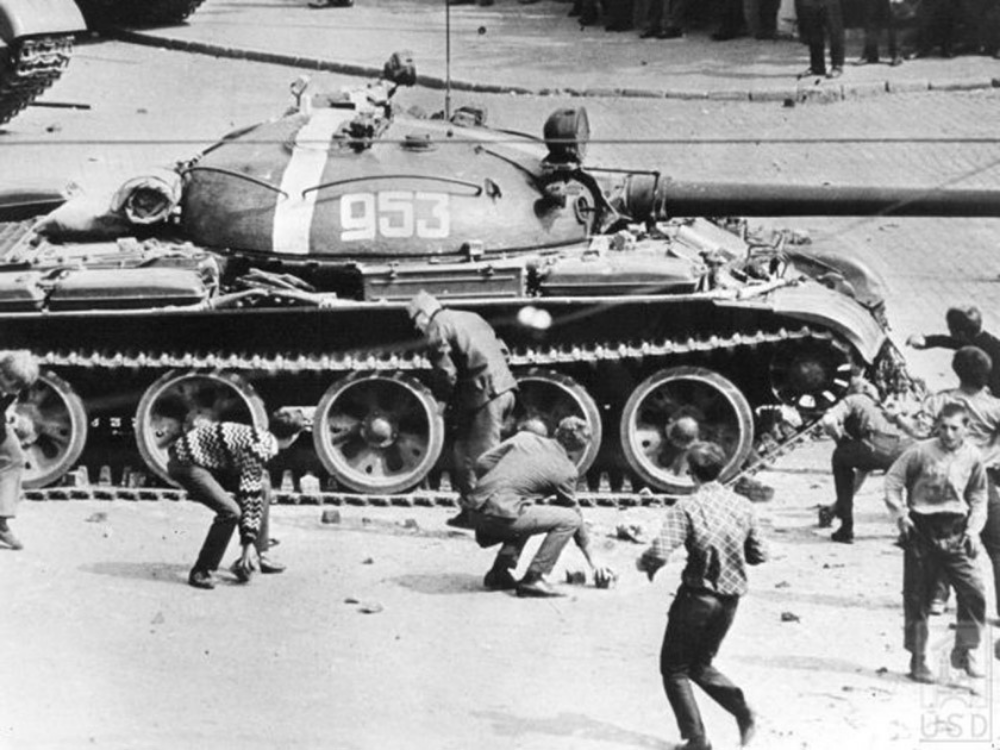
To many, the Soviet invasion of Czechoslovakia in August 1968 was a harbinger of things to come.
This month marks my father’s 125th birthday. Born in 1899, he came of age during World War I, a time of great global disorder. Nor did the war’s end stanch the disquiet. In 1918, my restive father dropped out of Columbia and boarded the French line “La Lorraine,” hoping to travel from Paris to Moscow for a close look at the unfolding Russian Revolution. He didn’t make it, but the effort opened the road to an adult life as a journalist, a radio commentator, and an astute observer of global political affairs. Even on his deathbed in 1974, he wondered aloud what the future might hold in store.
So it is that I wonder what he might think of today’s troubled planet.
Would he, like cautious Henry Kissinger, who died at age 100, describe this stricken planet as being more dangerous than at any time in his century of life? Would he, like lifelong intellectual radical Noam Chomsky, now 95, say much the same? (Perhaps the only time ever that Kissinger and Chomsky saw eye-to-eye.)
My father’s favorite political line was a chastening one, “If you can see it on the horizon, it’s already too late.”
In spirit, both men shared a Yeats-tinted “the center cannot not hold” approach to what they perceived as calamities in the making. Born into the Stalin era, when Soviet reach was global, both men also, and not surprisingly, warned of a potentially contaminating peril arising like a virus from Russia’s expansionist powerplay in Ukraine, seeing it in more dire terms than Middle East strife because of the war’s European implications (in fairness, Kissinger died before the worst of the Gaza holocaust, which as a lifetime negotiator he likely would have come to decry). Both warned of the formation of new alliances no longer at all beholden to the wishes of the United States. Elsewhere, their list of worrisome woes included Iran’s implacable (albeit decades old) bellicosity, the fragmentation of Middle Eastern and African states such as Yemen, Sudan, and Somalia, China’s Asian designs, and Europe’s inability to come to terms with migration, the issue giving rise to a host of far-right parties with neo-Nazi traits.
One might describe these concerns as a rant put forth by worries ancient. If only the heads of MI6 and the CIA hadn’t joined forces to produce an essay stating more or less the same worries in terms that can be read only as stark. For the chiefs of the two intelligence agencies, these times that try men’s souls were destined only to deteriorate and eventually produce head-on confrontation between nuclear players.
My father’s favorite political line was a chastening one, “If you can see it on the horizon, it’s already too late.” Which would suggest that all this doomsaying is useless. The worst is already in motion.
Yet my father had a remarkable subtle streak that allowed him to often read between the lines. He sensed for example that the Russian economy would be hard-pressed to sustain Soviet-style communism indefinitely. Cracks would appear in leadership or the people might revolt, perhaps both. He was dead right about the cracks, and within fifteen years of his death the Berlin Wall was gone, the Soviet Union soon to follow.
Because my father was fascinated with Russia and the tensions provoked by the Cold War, I suspect he would have had an unusual take on present-day Cassandra-ists. Namely that while all the woes they underscore are correct, part of their endgame worries are the product of a strange nostalgia.
All of those mentioned previously, including the younger MI6 and CIA bosses, grew up at least in part during the bipolar era, in which the standoff between Moscow and Washington made the world a simpler place. Despite fear of a global war between the two behemoths, a strong undercurrent existed suggesting no other states would become entangled in a conflict that would cause the mighty twosome to act against each other. Israel and Arab states waged war in the Middle East, but both sides were mindful of the larger global picture, with the U.S. exerting pressure on Israel and Russia doing the same on partners such as Syria. Though India and Pakistan loathed each other and often fought, neither side wished to induce a Russian-American clash. Western Europe faced an East dominated by Communist Bloc states, but the intense friction between the two sides was also reined in thanks to the bipolar landscape.
Despite fear of a global war between the two behemoths, a strong undercurrent existed suggesting no other states would become entangled in a conflict that would cause the mighty twosome to act against each other.
In a word, the world of my father’s time was beholden to the moods of two superpowers no one wished to truly vex.
Now that the world is fully outside this political map, the brushfires and full-forest fires that rage in places such as Ukraine and Gaza seem that much more daunting. Who or what exists to bring such enmities to heel? Nothing. No one. And as a result, old men and new fear what they’ve never known, consequently fearing a contagion of conflicts that might result in a fiery pandemic. They borrow from the fears of a pre-World War II past and cast that worry into the future. They might be right, but they might also be exaggerating, using old anxieties to diligently sculpt new ones. This is especially true of Kissinger and Chomsky, both men more or less of my father’s generation and thus accustomed to bipolar standoffs, or stand-downs.
Thus when I think of my father at 125 I think of this, an eccentric if insightful take on the prevailing alarmist sentiment. He no doubt would have worried about Ukraine and Gaza but would have noted that Russia, or at least Vladimir Putin’s Russia, saw Ukraine in a Soviet way, as its own. Never mind the matter of independence and other Western concepts. If Texas broke away, would not the United States intervene? As for Gaza, militant Arab independence movements have as their only major ally Iran, considered a rogue state in the post-Cold War universe.
It is a universe both ancients and moderns are as yet unfamiliar with, so they imagine the worst. But is that worst truly on the horizon? Is the planet on the brink of some imminent final disaster after two states with unlimited nuclear power managed to make it through the direst of forty-year nights?
On his mid-October birthday, my father would have said no.
 christopherwinner.com