
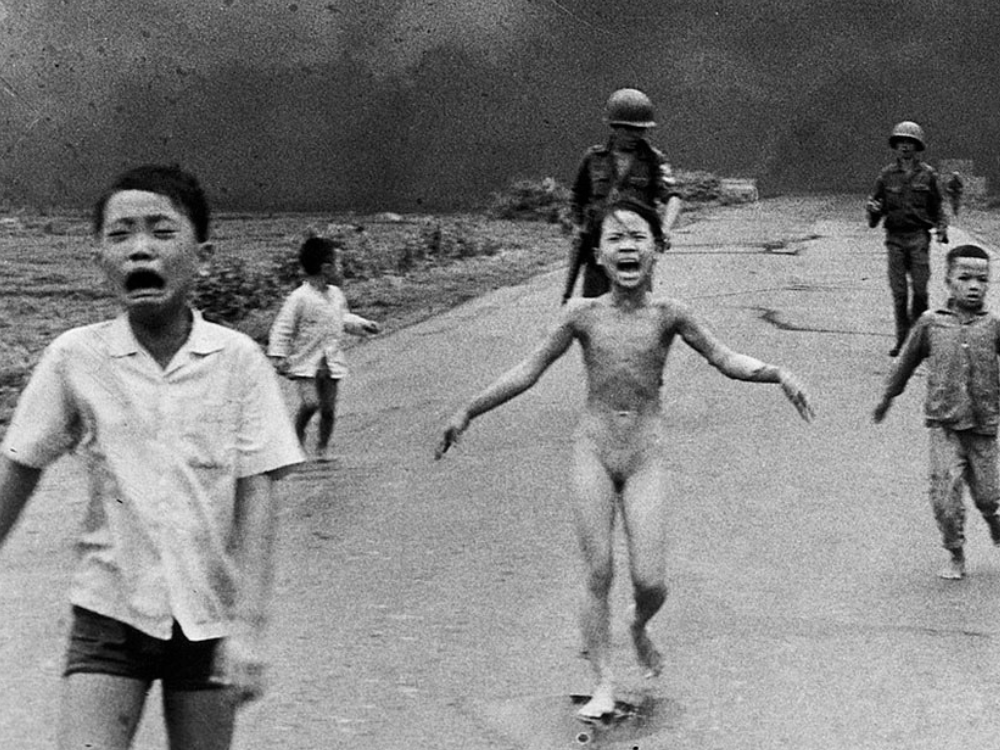
The use of napalm on civilians was just one of the many crimes committed by the U.S. in Vietnam.
One of the most durable phrases in the Pentagon’s Vietnam War–era arsenal of euphemisms consisted of two words, protective reaction. A “protective reaction” was any action, including air strikes, the spreading of napalm and chemical defoliants, or the razing of a village by American ground troops, that could legitimately — in Pentagon eyes — be considered necessary to “protect” the military interests of the United States. Those old enough to have lived through that war, including those who were students then, know full well that the expression was at times wickedly misused to erase incursions that had nothing to do with protection and everything to do with unjustifiable acts of war. So dirty was the conflict that military officials felt the need to construct a vocabulary of slang to distract from the daily mayhem produced by both sides.
Since the guerrilla enemy, the Viet Cong, often positioned fighters among civilians, the protective reaction seemed an ideal figure of speech to suit a conflict awash in blurs. Simply put, winning such a war required secrets and lies — both of which failed to save American forces from an ignominious defeat.
Now, well over fifty years later, comes a new entrant in the protective reaction racket: Israel. And it has donned the phrase slyly.
A “protective reaction” was any action, including air strikes, the spreading of napalm and chemical defoliants, or the razing of a village by American ground troops, that could legitimately — in Pentagon eyes — be considered necessary to “protect” the military interests of the United States.
Just over a year ago, Palestinian guerrillas under the Hamas “flag” attacked Israeli settlers in occupied Gaza, killing more than 1,200 and taking hundreds of hostages. That the attack demanded a reprisal is disputed by almost no one. That ferocious reprisal saw Israel all but lay siege to Gaza. So far, so good, at least in terms of military strategy.
But then, out of this situation and much in the vein of American strategy in Vietnam, came arrogance, and with it opportunism. And from the two, the old spirit of protective reactions.
Gradually, all attacks in Gaza, however corrupt, became part of Israel’s effort to defend itself. Even the bombing of hospitals and other civilian targets were stitched into the latest concept of protection. Did not Hamas guerrillas hide among non-combatants much in the way the VC had? The answer was yes, and so it was that the protection intensified, soon seeming to become indiscriminate. Not so, replied Israel. We fight to protect our borders and ensure our citizens are freed from captivity.
This, by now, is nonsense.
Israel recently bombed “liberated” Syria to ensure a new government was neutered. Before that it had bombed deep into Lebanon to protect Israelis from the rogue actions of Hezbollah, another terrorist group. At this point Israel, which has potent allies, including the United States, would have done well to do what America failed to do in Vietnam: declare war on hostile neighbors, or states and areas perceived as hostile.
But Israel chose, and continues to choose, the morally bankrupt American model. Everything it has done and will do is a grand and noble protective reaction.
Arab states appear not to care a whit about Palestinians, and the incoming U.S. administration has promised more fire and brimstone if the hostages are not released. Should President-elect Donald Trump add American muscle to Israel’s fight, all stand to witness the greatest protective reaction ever mounted, and let the euphemisms cheer. While the children weep.
 christopherwinner.com