
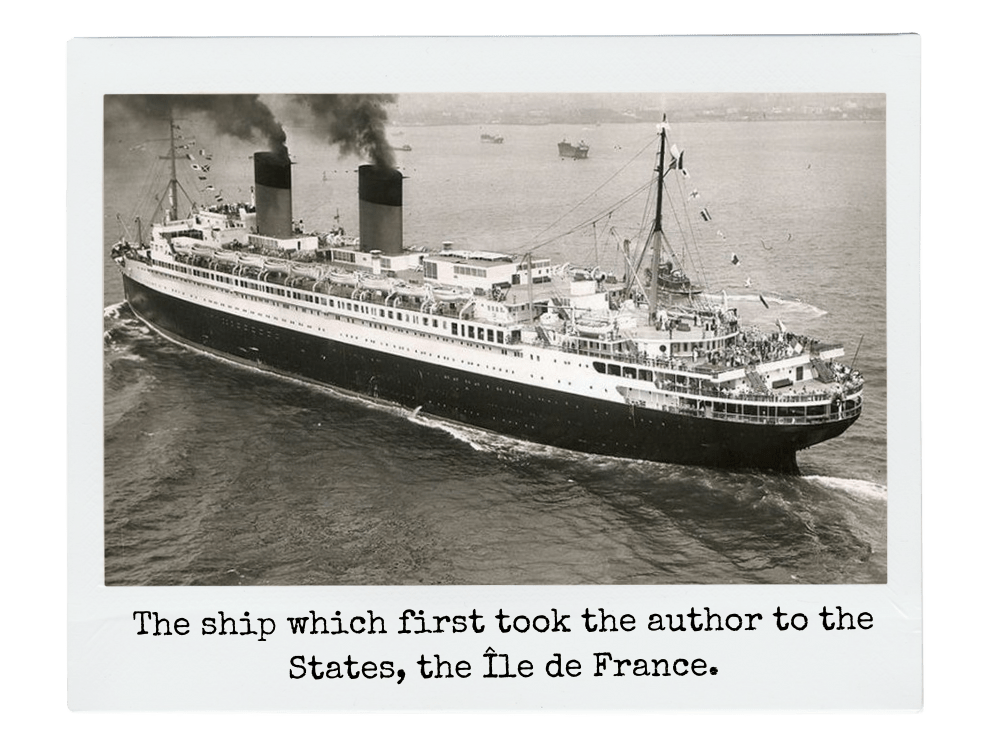
My first and most tyrannically absolute memory of childhood, one free from the grainy coaxing of black and white photo albums, is my apprenticeship with the elevator boy on the French ocean liner Île de France, while sailing from Le Havre to New York with my mother in the early spring of 1957. I was into my fourth year at the time and no other early recollection I have stands so fully on its own merit. I even remember the purpose of the trip, and this may have been before I even understood what purpose was or meant: we were headed from France to the United States, to Washington, D.C., where my father had found work.
I, of course, knew nothing about work, nor did I know with any certainty that I had been born in Paris to a stateless mother born in Warsaw but who identified herself as French and spoke only French around me. With my father she also spoke in Italian but English was not at that time on the surface of the planet or the sea for her or me. What little language I did know was the same as my mother’s, and only reluctantly did she relinquish French and Italian to what would become fluent, accented, but elegant English.
We were on this grand vessel because my mother feared flying. Later, she would tell me she was involved in an “incident” involving a plane during World War II, while traveling to Sicily with an American military official she may or may not have been involved with at the war’s end. In any event, planes were off limits, and the only way to cross what was considerably broader than a pond was to board an ocean liner, first class only (at least for my mother), and sail from England or France to New York harbor.
By 1957 commercial jetliners were beginning to nibble at the transatlantic route, a nibble that within a few years would become vast mouthfuls, all but consuming what was left of the ocean liner platter, already made modest by years of love for the air.
Gilles would place his small hands on my tiny ones and demonstrate how this machine could go up and down.
This had no effect on my mother. She pretended the sky was empty. I was finally able to coax her to fly — I held her hand tightly — only twenty-five years after that crossing.
Why my Parisian infancy is such a blur remains an infancy. I was cared for by nannies. We lived well, on a popular central street, and my parents had elite friends, including the likes of Albert Camus and Merleau-Ponty. My father worked full time for UNESCO, the United Nations cultural organization, and was the New Republic magazine’s European editor on the side. These are among the many observations hindsight affords, since at the time I was little more than a fat lump of whining flesh, weeping copiously when asked to eat or sleep, so much so that my screaming once caused the conductor of a French train to warn my father we’d, all three of us, be evicted if I didn’t stop my determined and pitch-perfect wailing. This was on a journey from Paris to the Jura Mountains and, of course, I remember nothing. From my vantage point, if I had one, I’m sure I thought of myself as delightful, the perfect kind of blob to go with so odd and mixed a family as mine, with my Polish mother and my Brooklyn-born father, more than two decades separating the age of husband and wife, twenty-two to be precise, and my own birth coming as my father approached what my new country, America, liked to call The Golden Years.
If this is a lengthy preamble to elevators on ocean liners, it’s important to understand that the liner for me, and what happened in the days of the elevator, represent what I first recognized as personal independence, and I never strayed far from either my love for liners, which I held onto until their bitter end, or my affection for eccentricity, which included deciding the elevator boy and not my mother was the lord of my universe and would rule it for the length of that crossing, to wherever it was we were headed.
As for the specifics of the memory, they include me dressed in some sort of half-baby-sized blazer, worn each night to the early dinner sitting aboard the liner. How we got to the ship itself, by special train from Paris to quayside at Le Havre, my mind’s eye refuses to play back.
Not so the awful dining room I repeatedly fled from, to get back to the elevator boy and watch him manage the rotating handles. How old he was, I don’t know, but he was too nice to be an adult and allowed me, when the elevator was empty, to rotate the handles. He’d place his small hands on my tiny ones and demonstrate how this machine could go up and down. I remember thinking how amazing it was that we were on the open seas, the fierce Atlantic, and yet protected from all that in this forward-moving bubble that also had a machine that went up and down in its belly, as if to ignore if not trifle with the ocean outside.
Several times my mother was called to the dining room by attendants who had found me absent and tracked me down with the elevator boy, who was chided, but smiled and shrugged his shoulders. When the baby-dinner-room authorities dressed him down, I’d begin wailing to make them stop, and in this way we reached a pact in which he’d tip off the baby staff I was safe and with him and they in turn, exhausted by my escapes, would stop alerting my mother.
So it went that in the time it took us to cross that ocean, six days, I spent most early evenings with the man-boy I would later learn was called Gilles, and who was enjoined to wear a red uniform with brass buttons and a clown-like hat, all of which apparently established his elevator agency to adult first-class passengers who wouldn’t stand for just a man in a jacket. No, the elevator commander required his own ritualistic clothing, as if a member of a brass band, and I remember thinking of him as a member of an orchestra, some sort of colorful tuba or trombone player situated at the back but made ornate-looking so the audience would pay closer attention to the music they made. I knew about orchestras because my mother had apparently attempted to take me to a Chopin recital at age three (no nannies were present that day), but I wept so devotedly she was forced to leave. Not even the consoling approach of some of the musicians could calm me down, but my mother said I paused from my screaming to play with their tunic buttons and feel the felt inside their instrument cases. Maybe this is why I came to imagine the elevator boy as part-musician.
He also allowed me to speak, and at that time, at my age, such an allowance was rare. He called me his assistant among the adults in the lift and I would dutifully say the word assistant, or something like it, in French. I remember some adult women finding my presence delightful and others muttering imprecations about how modern mothers were allowing their children to take over the adult world. I hissed at these skeptics under my breath while maintaining an idyllic smile so as not to get Gilles into trouble.
One day, my man-boy Gilles asked my mother if he could take me on a tour through the ship, which he said might calm me down. Again, I smiled while quietly seething.
She agreed and we went to the bridge, in which I was lifted up high so I could see the sea, and the immensity of it stuck me dumb. I was taken out on the starboard bridge wing and allowed to feel the ferocious wind as it tried literally to impede the ship’s progress. I was held by two men to avoid being turned into a bird. I decided then I would always ride this way over oceans, a promise I could not keep, but tried to, as these stories will attest.
We later went to saloons and bards and finally to the top of the engine room, where I was allowed to listen to the gigantic noise of the turbines that caused the propellers to turn. An engineer friend of Gilles explained how the blade cut through the water and how electricity was essential to all things. I merely gasped and stared at the turbines.
Little Christopher, he said, speaking my name in French, tomorrow we leave, you leave, the journey ends.
Years later, when my love of liners grew more informed and concrete, I learned the Île de France had not begun its life as a French ship but as a German one, the Hapag-Lloyd Line’s Europa (sister to the Bremen), which sailed from Hamburg to New York throughout the prewar period. It became French (and the Bremen became American, renamed Leviathan) as a result of postwar reparations, a concept my father explained to me in such detail he’d often sail well past liners into the realm of politics and diplomacy, a tendency that anchored his character.
After the war, the Bremen became French, the pride of the war-decimated French Line, and was eviscerated internally to resemble all things French, like a waterborne adjunct of a Louis-like king from the pre-revolutionary era. Chandeliers were so abundant there was even a tiny one in the elevator that jingled and jangled as we moved from deck to deck. Engine vibration, a constant on a liner, caused all the many representatives of the crystal world to sway and make Christmas-like music box sounds. In heavy seas, some of the larger ballroom chandeliers were anchored to the side of the room with cables. On some vessels they could actually be pulled upward, closer to the ceiling.
It took only a few days to understand that while this ship might be protected from the sea in a basic way, it was also at its mercy, and that the Atlantic when angry could do as it wished with all things human. I wondered later on stormy days if the sea’s smashing against a liner’s side wasn’t a form of laughter, as if to say, “And you think you’re safe in that cocoon of yours!”
None of this touched me in the elevator era. I spent that time of life appreciating someone who chose to be kind and playful with me and to stare at the rigid pettiness of adults, all dressed perfectly but in the same way, the only variation being the colors of the women’s clothes.
When I was with my mother in the elevator, Gilles said nothing. She looked on as a princess, which is as she wished it, and in the looks of men there was no doubt some question over who she was, this stunning blonde woman in her mid-thirties with no man at her side, flanked instead by me, no doubt a paid if tiny executive secretary who trailed after royalty by rote. I felt no vibrations other than the ship’s and yet it was clear my mother emanated something that cast a sort of spell over men, which in turn made them more tolerant of my wish to do things my way. Not a single other child on the ship did what I did, attaching himself to an adult, or to a machine, as I did to Gilles and the elevator. In this way I was my own royalty.
The evening before we docked, Gilles said good-bye, and I refused to understand it, as if my own intention was not to disembark but continue my ocean liner career as an apprentice elevator boss. Little Christopher, he said, speaking my name in French, tomorrow we leave, you leave, the journey ends.
To which I simply and very surely said, No.
He tried another approach, suggesting we might see each other again on another crossing but for now the adventure was over.
To which I said, No.
And I still say it now.
— This is one in a loosely linked series of autobiographical essays in which the author recollects his childhood years, spent largely in Washington, D.C., and Madrid, Spain. Some names and details have been altered for reasons of privacy.
 christopherwinner.com