
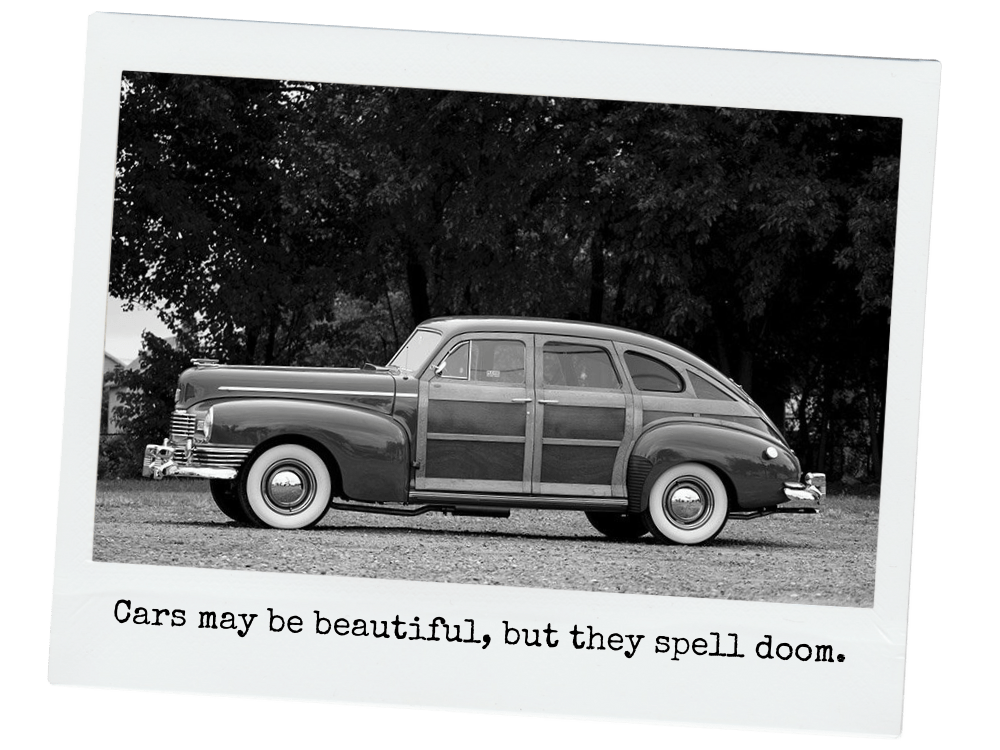
In June of 1959 my favorite beach car was made by a company called Nash. I came upon my favorite Nash, vintage 1947, parked underneath the white water tower, a great building that I was told contained desalinated water, enough to give the entire boardwalk community enough drinkable water in the event of a calamity.
Since I did not know what a calamity was but I did like the green Nash and the tower, I pulled them into my magic world, like places of worship. Not a day passed that I didn’t walk from the Wilmington Avenue cottage to the tower and the Nash. This pilgrimage was also an homage to endangered species, though this I did not know.
When I returned to the town a decade later, the tower was gone and the Nash was long gone, replaced here and there by cars that came from Japan, which people said with such disdain it was as if the cars should not have survived the swim.
Another reason for my love of the Nash was that Gus at the pizza parlor said he thought the Nash was Daddy-O, another mystery but since it included a reference to my father I took the car into my heart. Gus also told me how much he disliked Cadillacs, which he said would soon grow fins. This was among the most perplexing statements I heard at the beach in those early years, and asking my father if a car could grow fins seemed outlandish, even to me.
Gus also told me how much he disliked Cadillacs, which he said would soon grow fins.
Gus would later explain to me the amazing concept of headlights and taillights and how people in Detroit, apparently a city somewhere far away, worried day and night about what might seem “cool” to consumers. Since he always bought me ice cream, a vanilla cone, I didn’t bother to ask him to reconcile cool with the hot beach days.
The Nash was a funny, awkward car that seemed to me not to really want to be a car, assuming cars had a choice, which I thought maybe they did. This also might account for a Cadillac wanting to grow fins, not a matter of looks or consumer “cool” but simply the inner desire cars have to change a bit from year to year.
I never said any of this to my father or mother but did tell Gus, who would just nod his head and say, “kids,” a word I took as a compliment, since it sounded pleasant enough. Kids also reminded me of Keds, a kind of shoe athletes wore and I saw in store windows with cheerful, colorful ads suggesting if you wore them you could run faster and even perhaps fly. I had my doubts about the latter, since I had tried to leap from the boardwalk to the sand with a big towel – the wind blew hard from the sea – but ended up flat on my face as two girls giggled. That day I gave up on flying for good, until my father took me to an airport a few years later. At least there I didn’t have to bring a towel or do the work.
Gus was in love with a song he called Jane Be Good, which, when he played it for me, seemed to have nothing to do with Jane or goodness. But how could I know, with my fractured English. When I asked him about Jane he was actually very kind. As always, he stared with his affectionate exclamation, “Kid!”
Jane was not Jane but Johnny, and being good meant the opposite of that, and the guitar was a sacred instrument: this was the first part of the lesson. The second part concerned the holiness of specific singers, including one actually called Holy. Or so I thought for a moment. “Not Holy. Holly, Buddy.” And that was how I came to learn both about Buddy Holly and later what a buddy meant in slang. In this way, Gus was my early Wikipedia. Buddy Holly had died in a plane crash with another man and the The Big Bopper. Still, they were “hip,” and along with Jane and Johnny were essential to rock’n’roll, which I, of course, understood only as rock and roll, assuming the players who did the music must move a lot and perhaps even squirm, maybe even in the sand.
Safe to say, Gus taught me a great deal, though neither one of us saved the Nash or was able to stop the Cadillac from growing fins.
So now I understood death. In the presence of cars and trucks, pets could vanish at any time, no doubt stolen by their drivers.
At the beach, after my flying attempt and my understanding of how the boardwalk ended, axis and Axis, I began to understand that no matter how hard I tried, certain things would not unfold as I wished them to. Some days the slice of pizza Gus served to my father was larger than mine, patently unfair, even cruel, but since I couldn’t fly, I’d better accept that slices varied by the day, in all things.
This struck me like an alien anvil from the sky when my favorite cat, Mort, the cat I petted every day on my way to the beach and apparently belonged to a neighbor, stopped appearing. My mother, tired of my complaining that Mort had abandoned me, carried her princess looks to our neighbors, an elderly couple who sat all day on their screened porch. They explained the why of this to her but she refused to reveal it to me. Once again, I had to resort to my patented whining, as bad as rock and roll, at least to her eyes. She whispered something to my father who was at that moment reading on the couch.
He looked up at me, put the paper down, but only halfway, and told me Mort was dead, run over by a truck on the resort’s one main avenue.
I wasn’t sure I understood this, so I asked him whether Mort would be happy, assuming he’d somehow gone elsewhere.
Death is death, said my father. Mort had been a good cat, a Nash of Nashes, but now he was no more, and I shouldn’t expect to see him again. That was that.
I then asked Gus. “Kid,” he said, “pets don’t last forever when cars are around.”
So now I understood death. In the presence of cars and trucks, pets could vanish at any time, no doubt stolen by their drivers for reasons only Jane Be Good could answer.
Death, at the beach, lacked agents to explain it, at least to kids. Which, from time to time, left me waiting for a dead gull to rise up and fly back to where it belonged, in a place in which nothing alive ever stopped moving, like me.
If by chance you’re still out there, Mort, please know I still think of you and miss petting you and assume we’ll at some point meet — maybe with you out of the sun, hiding under the nearest Nash.
— This is one in a loosely linked series of autobiographical essays in which the author recollects his childhood years, spent largely in Washington, D.C., and Madrid, Spain. Some names and details have been altered for reasons of privacy.
 christopherwinner.com